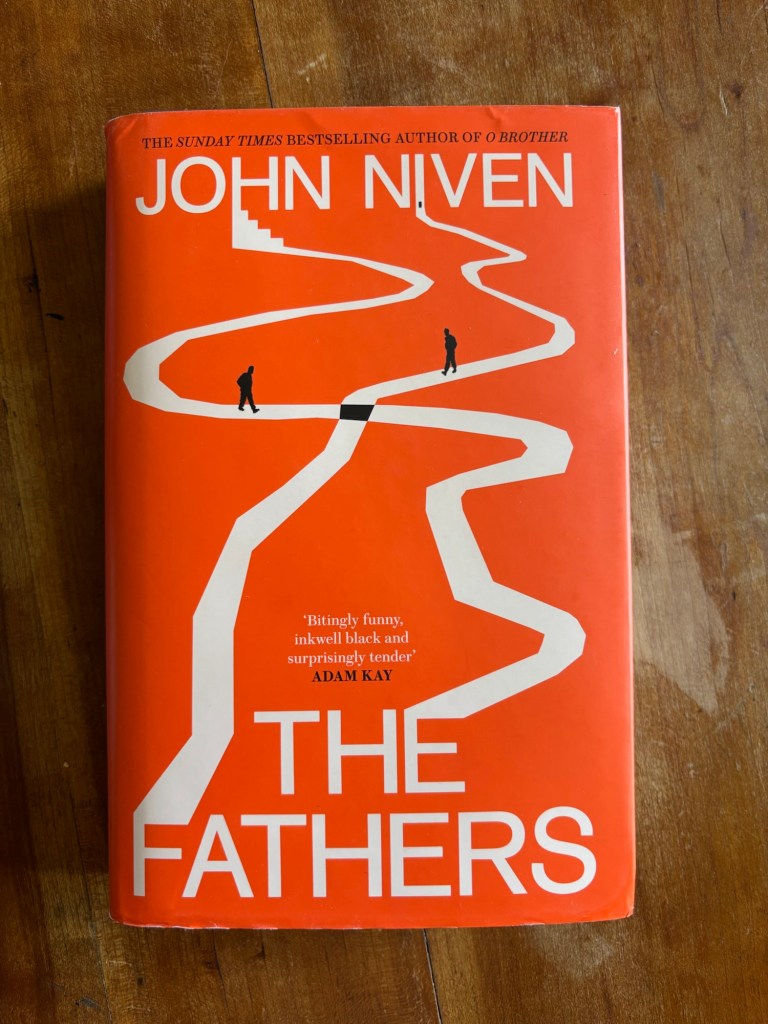
The Fathers: Rambling Review

A coincidence is all that’s necessary to set into motion matters of fortune and fate. What joys and tragedies are stirred as a consequence of experience? Two families each welcome their own baby boy, both born on the same day…and while meandering around the hospital, their fathers meet by chance. Friendships form, but not here…Dan and Jada couldn’t be more different, but when Dan’s world collapses, Jada becomes something of an enabler, and from there things spiral out of control in a pure ‘John Niven fashion’ that dropped my jaw more than thrice. ‘The Fathers’ is a top shelf addition to Niven’s body of work. 

This book had me laughing out loud multiple times, tear up on a few occasions, and with one moment I set the book to the floor and wept. I hadn’t been hit this hard since ‘The Blood of the Lamb’ by Peter de Vris. It’s a strange and liberating thing when art elicits an emotion you weren’t anticipating. I expect Niven will get me to laugh, think, and potentially cause me to shed a tear or two, but this was full-blown uncontrollable quiet weeping in the night. John is the kind of writer who conveys the human experience with such grace and grit, his work is nothing but the highest quality, and ‘The Fathers’ is his finest piece of fiction yet. 

My only criticism is that it had to end. This was such a pleasing read. From the heights to the lows beneath whatever you’d call ‘rock bottom’ of parenting, to a world of crime that ranges from petty to ultra violent, to the critique and commentary on class pitfalls and privileges, ‘The Fathers’ contains a range that keeps pages turning. The tone pivots from sentimental to wretched as quickly as one could read, and those moments are laid out in such a way…never thought I’d find myself laughing so hard at the description of a McDonald’s apple pie. 

      To break my heart with fiction is possible, but this book destroyed me. The obsessive ‘what-if’ moments that followed the tragedy is something that will trouble those knee-deep in grief. 

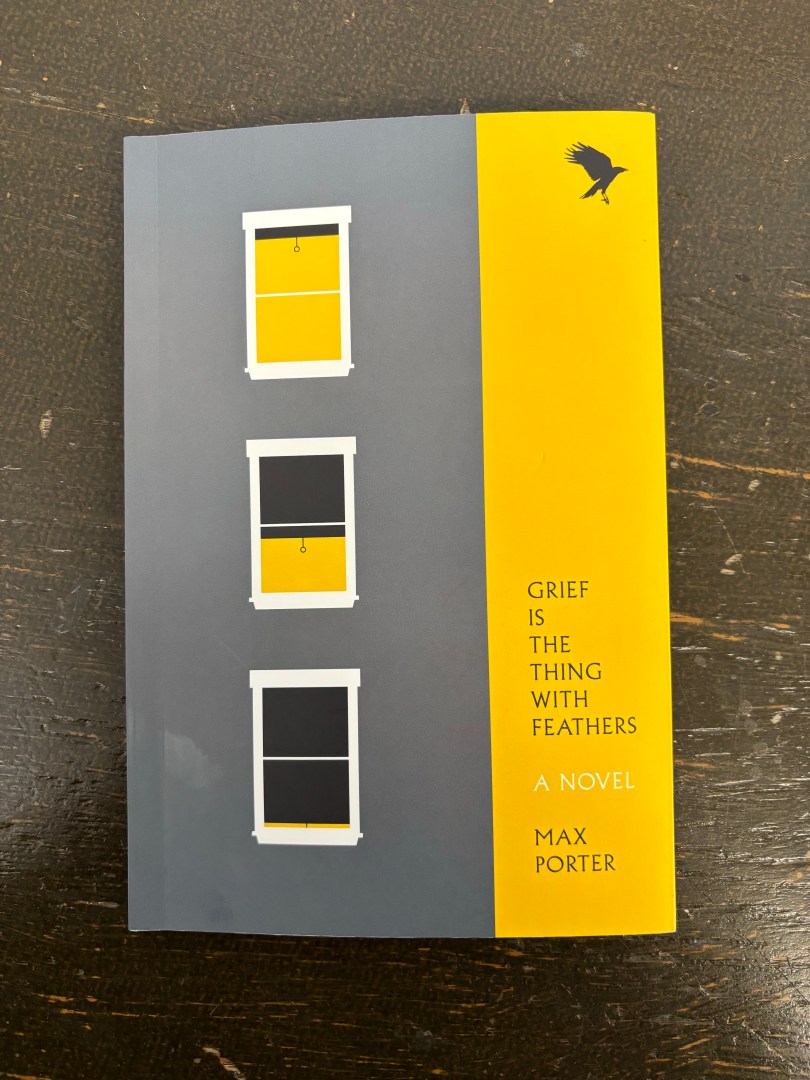
In another book that broke my heart, ‘Grief is the Thing with Feathers,’ a crow describes grief as an essential part of life, but to beware one’s dealings with grief do not dissolve into despair. Dan went beyond despair…finding a tunnel beneath his own rock bottom, and his character development surprised me. His mindset is as captivating as it is tragic. I thoroughly enjoyed ‘The Fathers’ by John Niven. I needed every bit of this book. 
Grief is the Thing with Feathers: a Rambling Review

Tragedy is the genre element that attracts me with the strongest gravitational pull. I live for stories that impact me with such force that I’m left doubled over in sorrow…makes me feel alive, and all that. But what of the aftermath? What of grief?

Most novels from modernity onward, have a tendency to include past events that haunt the present, making any future an impossible prospect. ‘Grief is the Thing with Feathers’ begins after the sudden and unexpected passing of an unnamed woman and does a great deal of perspective jumping between her widower, their two children, and a crow that visits and refuses to leave until our widower is no longer ‘helpless.’

The crow could’ve been any supernatural specter of sorts, but Max Porter’s decision to make this entity a crow reminds me of Poe’s ‘The Raven.’ Instead of encouraging madness in the face of loss, the crow seeks to comfort our widower by forcing him to deal with the discomfort in whatever dose he feels appropriate to administer in any given moment. The crow also seeks to protect the family from various demons (real or imagined) that would cause them to wallow in despair.

It reads more like a thematic collection of poetry than a traditional novel, but the narrative arch is solid, concise, and I feel like old friends with characters whose names are never given.

‘Grief is the Thing with Feathers’ is a fundamental exercise in loss, and is one of the most authentic expressions of grief I’ve read in fiction in some time. When the crow grants himself permission to leave, he refers to the boys as, “Connoisseurs…of how to miss a mother/My absolute pleasure” (110). In deriving pleasure in guiding them through grief, the crow makes clear his purpose: coaching on how to functionally live, without.

The novel concludes with the father and sons spreading ashes at a body of water. I was left broken by the line, “I said her name/The ashes stirred and seemed eager so I tilted the tin and I yelled into the wind/I LOVE YOU I LOVE YOU I LOVE YOU” (114). With this, I’ve learned that grief hits just as hard as tragedy, itself. It lingers long after the explosive event that changes lives, and shapes you into something different than what you were, before.

‘Grief is the Thing with Feathers’ is the second book to make me cry, this year.

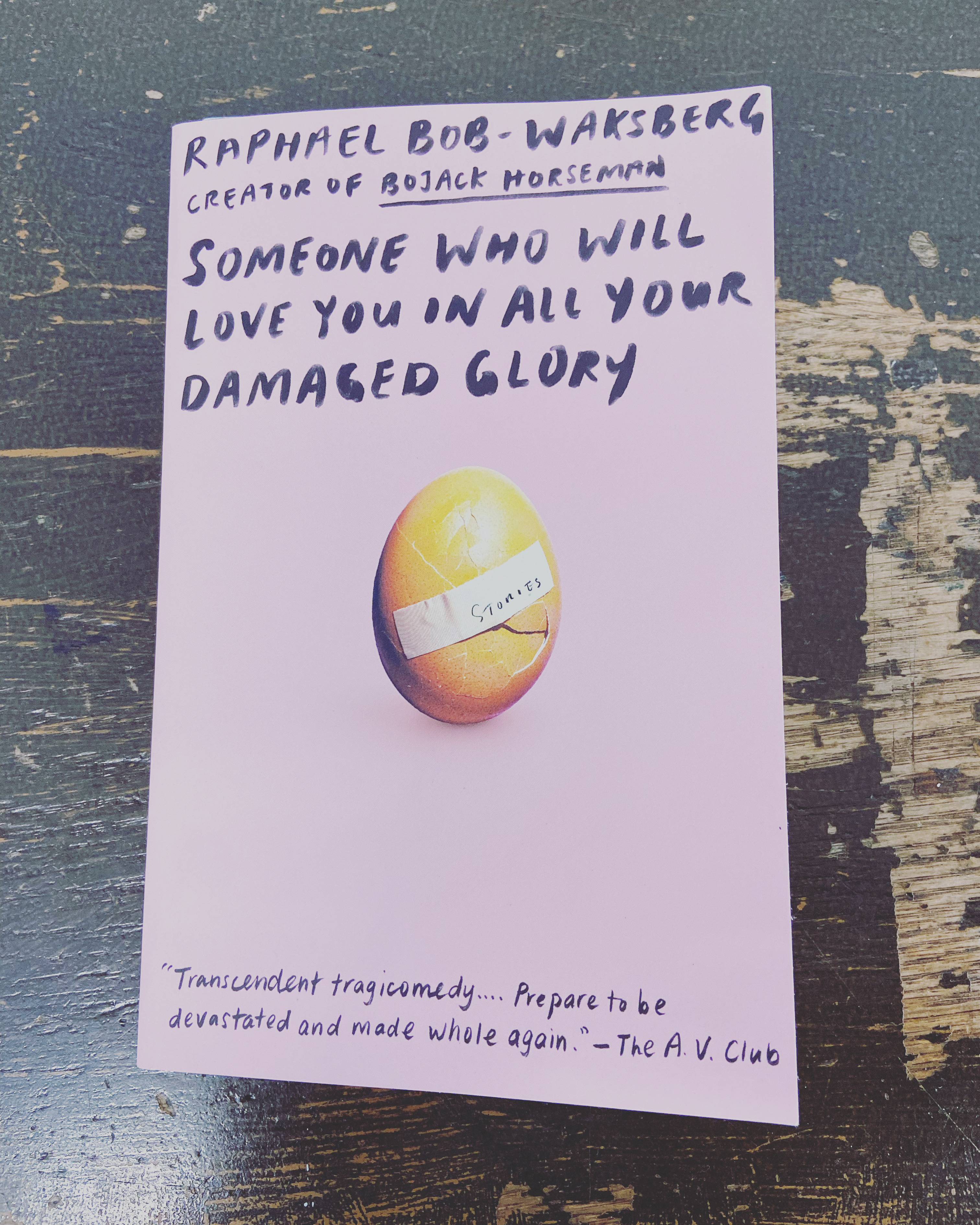
Someone Who Will Love You In All Your Damaged Glory:Rambling Review

I stumbled upon this book because I’m a fan of Bojack Horseman. It’s difficult to tell people, “No, seriously…it’s my favorite show.” I gave it a chance when it first came out, and checked out after two episodes. I thought it was funny, but maybe it was just another run of the mill raunchy animated adult comedy. It wasn’t until the fourth season had dropped that someone recommended it and I gave the show another spin. Had I just kept watching the first season I would’ve been hooked. The quality storytelling just kept getting better right up until Netflix does what Netflix takes joy in doing…you know…cutting a show down before it’s done. I’m eternally grateful that the writers were given a heads up and wrapped up the story as best they could with the time they had. But I digress, those six seasons of television remain among my favorite, and I don’t see anything coming close.

            So when I heard that the creator of Bojack Horseman, Raphael Bob-Waksberg, had published a collection of short stories, I jumped at the opportunity for something more. Someone Who Will Love You In All Your Damaged Glory stands on its own as something wholly independent and special, as I had expected it to be. It’s described on the back cover as an, “offbeat collection of short stories about love-the best and worst thing in the universe.” The subject of love is woven throughout each story through different angles. I initially believed I was in for a ride that explored romantic love and romantic love only, as the first 100 pages consist of narratives exploring exactly that. We break from the romantic variety with Rufus, a touching narrative from the perspective of a noble dog who loves his ‘Manmonster.’ While the manmonster engages with romantic partners and other various friendships, the story fixates on the relationship between the dog and person. You Want to Know What Plays Are Like? is a personal favorite that explores the complexities of family through the scope of frayed sibling relationships where our protagonist tells us about seeing a show written by her brother…that happens to be about a vacation they took. Their deceased sibling has her drug issues addressed in the play, a departure from the burden of their shared reality.

            Rewind a bit…I fell for this book immediately. I took my daughter to her weekly dance lesson, saw her into the studio, and went to a chair in the waiting room with the intent to break the ice. The first story is two little pages. A quick snippet of style and substance titled Salted Circus Cashews, Swear to God had me laughing in front of strangers as it broke my heart on the same page.

            These stories vary in length, ranging from a couple of pages to over 40. The collection isn’t tied to one approach, as we’re offered first, second, and third person accounts throughout. To circle back to the beginning, at a multitude of points I’m reminded of Bojack Horseman and the writing styles used to drive the narratives of the show, specifically, the internal dialog utilized in a day in Bojack’s life from an episode called Stupid Piece of Shit. It’s absurd at times, departing from cultural norms entirely to establish different imagined worlds…like how many goats should be sacrificed at a wedding? This was a lovely read that I truly enjoyed. For fans of the show, or readers who simply want to read about love with weighted nuance, Someone Who Will Love You In All Your Damaged Glory is worth the read.

I’m Thinking of Ending Things: Book Review

There’s a great deal I want to discuss with regards to the book, the majority of which requires me to spoil the ending. So much is tied up in the twist, and to only talk about the psychological buildup comes off as a sales pitch.

I’m into tragedy. A title like, “I’m Thinking of Ending Things” carries implications that I don’t feel need to be spelled out. The entire first page carries an ambiguity hinting of these thoughts being suicidal in nature, but is cleared up by our unnamed narrator describing how she intends to break things off with her boyfriend, Jake. I felt let down. It wasn’t outright dark enough compared to my initial expectations.

Things get weird, and the buildup is fun. You’re let in on glimpses of some tragic violence between chapters. Something bad is going to happen, but the where, when, and who is kept off of the table for the purposes of suspense. Reid knows how to develop a plot, and he knows story structure.

The book is crafted just fine. But the ending… The last twenty pages of the book and all I could think was, “It’s ‘Fight Club’ all over again.” The narrator is a figment of fantasy, a woman Jake met once. Jake has parents who appear on the page, but they’re long dead. The entire episode is of an imagination longing to compensate for want. Jake’s academic ambitions have been left in the past, he inherits the home in which he grew up, he is alone, and goes through a fantastic detachment that leaves him (and the time frame of the story) at the height of Jake’s potential. This window of time that places Jake in his late twenties to early thirties is subjected to the reality that thirty years have passed since the events of the story world. Has he and the narrator not aged in his fantasy? This obsession with youth and age shows that Jake is not as detached as the general narrative would have you believe. It’s much more depressing than your average thriller, but is painted as such because an alternative angle would turn off a good portion of the audience.

It’s not about having an original story, but telling it in an original way… I’ve heard similar expressions regarding storytelling, so I can forgive the ‘Fight Club’ ending. Where I take issue is the youthful angle of the fantasy, without which the entire narrative (as it is) cannot stand. The character is obsessed with the past, and to a degree I really dig it.

What if we knew Jake was in his sixties the whole time? What if we knew he was living in a fantasy world to make up for whatever he lacked? What if the title didn’t play with our preconceived notions about language, and was honest from the starting point? The book would’ve been entirely different, maybe less commercial, no over the top twist, but it would’ve been honest. A partner does not stability create. Jake is not honest with himself, his problems are not rooted in loneliness, but in serious mental complication by which his isolation is a side effect. Jake was always going to self-destruct, and a romantic partner would’ve made no difference, but it’s nice to pretend.

It was a fun and easy read, but I’ve got mixed feelings about the ending.

Ending things.jpg

Book Review: ‘The Blood of the Lamb’ by Peter De Vries

Great literature has often moved me to feeling, but never to tears until ‘The Blood of the Lamb’ by Peter De Vries. As described by the late Dr. Myers back in 2013, the book is, “a comedy about a man whose child dies of cancer.” With this spoiler in mind, I was still left unprepared for the impact of the prose upon my heart.

In truth the novel follows Don Wanderhope from his early childhood through the loss of his daughter, Carol. We don’t meet Carol until the final third of the book, but to that point we are exposed to the persistence of loss, and the complications of faith in the face of such experience.

The death of a young lover brings Wanderhope to question the overseeing doctor on a belief in God, and we are given a great insight to the nature of doubt,

“He just perceptibly raised his eyes, as if in entreaty to Heaven to spare him at least this. It took me some years to attain his mood and understand my blunder. He resented such questions as people do who have thought a great deal about them. The superficial and the slipshod have ready answers, but those looking this complex life straight in the eye acquire a wealth of perception so composed of delicately balanced contradictions that they dread, or resent, the call to couch any part of it in a bland generalization. The vanity (if not outrage) of trying to cage this dance of atoms in a single definition may give the weariness of age with the cry of youth for answers the appearance of boredom. Dr. Simpson looked bored as he ground his teeth and gazed away” (111).

Our narrator is a tragic embodiment of something that relates to the human condition. In describing the conflicts of his marriage he observes, “one of those subtle shifts of mood that emphasize how much we live by one another’s variable weather” (147).

But no matter the weight I’m well versed in tragedy. It is a subject matter or genre that brings me a peculiar pleasure. Morbid as it may seem, I delight in such material as it brings me the comforts of community. Upon fighting the ‘beast’ that is Carol’s leukemia, Wanderhope suggests that in the face of a terminal illness, medicine is, “the art of prolonging disease” (183), and that the notion of progress serves only to infect the wound, as, “Progress doubles our tenure in a vale of tears” (242). It is with the loss of Carol that Wanderhope is able to admit that, “Time heals nothing” (246).

The Blood of the Lamb is a hard-hitting piece of work, with a style of prose that tells more than it shows. It’s in this telling that we relate to such loss through empathy. Knowing that the entire book was leading up to the death of a child made it no easier to read the passage in which Carol was lost. I had to put the book down on several occasions, but in returning I always found more value than I had expected, and more emotion than I could handle at times. This was the kind of tragedy that goes beyond standard literary merit… this book moved me to tears more than once.

What makes it so difficult is knowing how closely the story mirrored the life of the author. It’s what made it all so authentic. His conflicting thoughts on faith, and his sharp observations of love, and life, and hatred, brought me to care in such a way as to suggest true feeling… My apologies, for this is not my typical review of sorts… I’m still dealing with the loss described on the page.