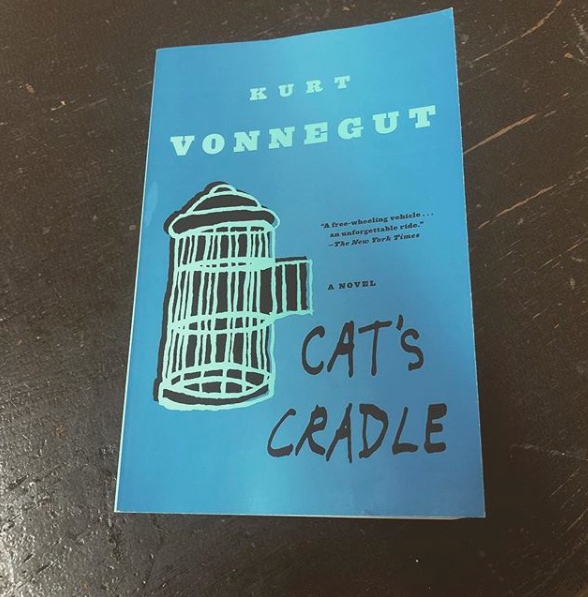
Cat’s Cradle: Book Review

Vonnegut is one of those authors I’m surprised was never assigned during my time as an English major. I did spend a good deal of time studying Renaissance drama and folklore, but I thought my time in classes that emphasized novels of the 20thcentury would’ve provided me with the likes of him and Atwood. As with Atwood, I would delve into their works after my time in the classroom.

Cat’s Cradle entertained, as I found the ride to have gone through unexpected turns. Even with science as an underlying subject I wasn’t expecting the sci-fi elements that emerged later in the book.

The juxtaposition of science fiction elements with the political/religious commentary allowed for some delightful satire. Some of my favorite passages involved the folly of American prejudice as human condition, and capitalism gone too far. One such passage reads,

“I guess Americans are hated a lot of places.”

People are hated a lot of places. Claire point out in her letter that Americans, in being hated, were simply paying the normal penalty for being people.” (98)

Another passage that caught my eye…

“The hand that stocks the drug stores rules the world. Let us start our Republic with a chain of drug stores, a chain of grocery stores, a chain of gas chambers, and a national game. After that, we can write our Constitution.” (285)

The book contains casual racism and sexism, which I’ve come to expect from male authors of that era. If you can get past that it’s a brilliant read. Much like Atwood, I’ll be reading more Vonnegut.

Screen Shot 2018-09-22 at 9.34.38 PM

I’m Thinking of Ending Things: Book Review

There’s a great deal I want to discuss with regards to the book, the majority of which requires me to spoil the ending. So much is tied up in the twist, and to only talk about the psychological buildup comes off as a sales pitch.

I’m into tragedy. A title like, “I’m Thinking of Ending Things” carries implications that I don’t feel need to be spelled out. The entire first page carries an ambiguity hinting of these thoughts being suicidal in nature, but is cleared up by our unnamed narrator describing how she intends to break things off with her boyfriend, Jake. I felt let down. It wasn’t outright dark enough compared to my initial expectations.

Things get weird, and the buildup is fun. You’re let in on glimpses of some tragic violence between chapters. Something bad is going to happen, but the where, when, and who is kept off of the table for the purposes of suspense. Reid knows how to develop a plot, and he knows story structure.

The book is crafted just fine. But the ending… The last twenty pages of the book and all I could think was, “It’s ‘Fight Club’ all over again.” The narrator is a figment of fantasy, a woman Jake met once. Jake has parents who appear on the page, but they’re long dead. The entire episode is of an imagination longing to compensate for want. Jake’s academic ambitions have been left in the past, he inherits the home in which he grew up, he is alone, and goes through a fantastic detachment that leaves him (and the time frame of the story) at the height of Jake’s potential. This window of time that places Jake in his late twenties to early thirties is subjected to the reality that thirty years have passed since the events of the story world. Has he and the narrator not aged in his fantasy? This obsession with youth and age shows that Jake is not as detached as the general narrative would have you believe. It’s much more depressing than your average thriller, but is painted as such because an alternative angle would turn off a good portion of the audience.

It’s not about having an original story, but telling it in an original way… I’ve heard similar expressions regarding storytelling, so I can forgive the ‘Fight Club’ ending. Where I take issue is the youthful angle of the fantasy, without which the entire narrative (as it is) cannot stand. The character is obsessed with the past, and to a degree I really dig it.

What if we knew Jake was in his sixties the whole time? What if we knew he was living in a fantasy world to make up for whatever he lacked? What if the title didn’t play with our preconceived notions about language, and was honest from the starting point? The book would’ve been entirely different, maybe less commercial, no over the top twist, but it would’ve been honest. A partner does not stability create. Jake is not honest with himself, his problems are not rooted in loneliness, but in serious mental complication by which his isolation is a side effect. Jake was always going to self-destruct, and a romantic partner would’ve made no difference, but it’s nice to pretend.

It was a fun and easy read, but I’ve got mixed feelings about the ending.

Ending things.jpg

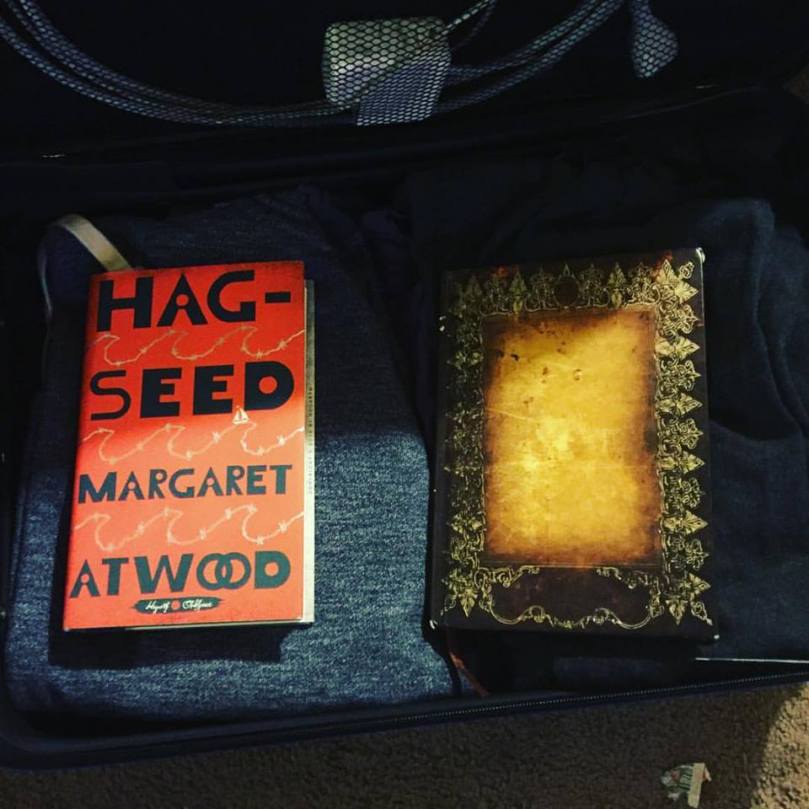
Hag-Seed: A Rambling Review

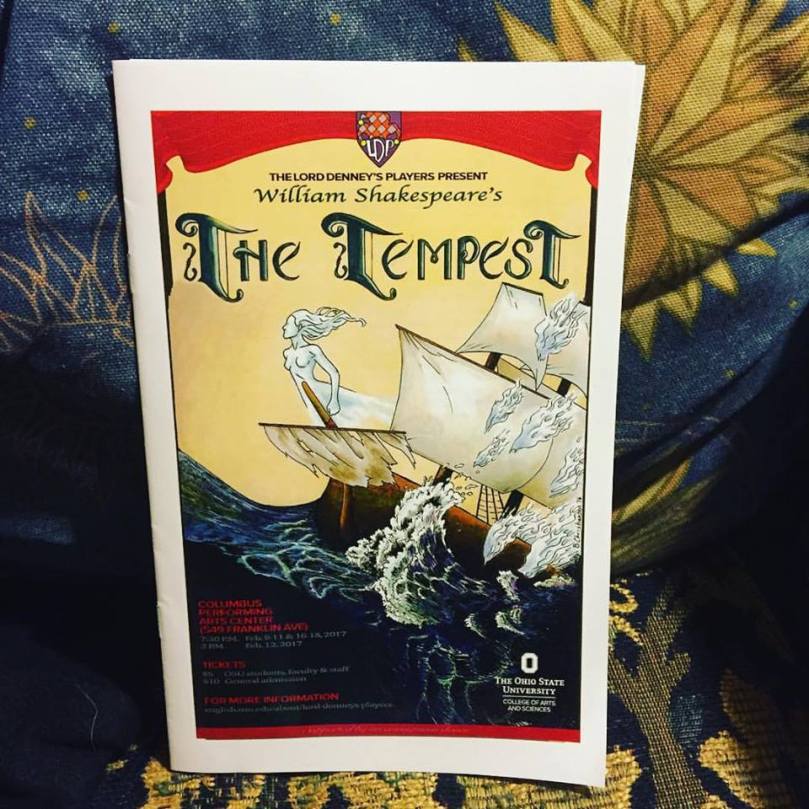
Strange to think that in my time as an English major I never read The Tempest, or Margaret Atwood. I have The Lord Denney’s Players to thank for the recent exposure. The theatre company is of the Ohio State Department of English, and their emphasis is on the Renaissance. With this production they’ve chosen to put on The Tempest. In order to familiarize myself with the text and story I read Shakespeare’s work, an article by Stephen Greenblatt, and Margaret Atwood’s retelling in a contemporary prison, Hag-Seed. All of which were wonderful texts (as I’ll get to Hag-Seed in a moment), but that breathing entity of theatre was something fantastic to behold.

I started reading Hag-Seed a day or two following my completion of The Tempest. Atwood bridged the gap, from text to stage. Her novel begins with a Prospero figure, and his work as a Shakespearian theatre producer. Every piece is there; political betrayal, exile, revenge, and forgiveness as prompted by the figure of Ariel, an inmate known only as 8Handz.

But the best qualities of a retelling are in what makes it new. Long has the topic of prisons been applied to conversations on The Tempest, but Atwood has sculpted a narrative of her own, with the actual play as the underlying plot point. Freakin’ meta, man… but it gets at some parallels that prove Atwood is a master of her craft.

Most of the novel seems grounded in reality, but there are moments that are just fantastic. Felix (the figure for Prospero) getting away with his crazed hostage taking revenge plot is too good to be real, but such is the stuff of great fiction, and such is Shakespeare’s text. If you’re really looking for an over the top reworking of Shakespeare check out South Park, season five, episode four: Scott Tenorman Must Die. That mess recreates Titus Andronicus, and it’s dark. Sorry, that got off subject.

I’m new to the Margaret Atwood fan club, but I’m looking forward to reading more of her work. Aside from The Handmaid’s Tale, what else of hers should be at the top of my list?

16114235_10206892117294962_3398982135386129746_n.jpg16649414_10207045690574198_346283771551689809_n.jpg

Book Review: ‘The Blood of the Lamb’ by Peter De Vries

Great literature has often moved me to feeling, but never to tears until ‘The Blood of the Lamb’ by Peter De Vries. As described by the late Dr. Myers back in 2013, the book is, “a comedy about a man whose child dies of cancer.” With this spoiler in mind, I was still left unprepared for the impact of the prose upon my heart.

In truth the novel follows Don Wanderhope from his early childhood through the loss of his daughter, Carol. We don’t meet Carol until the final third of the book, but to that point we are exposed to the persistence of loss, and the complications of faith in the face of such experience.

The death of a young lover brings Wanderhope to question the overseeing doctor on a belief in God, and we are given a great insight to the nature of doubt,

“He just perceptibly raised his eyes, as if in entreaty to Heaven to spare him at least this. It took me some years to attain his mood and understand my blunder. He resented such questions as people do who have thought a great deal about them. The superficial and the slipshod have ready answers, but those looking this complex life straight in the eye acquire a wealth of perception so composed of delicately balanced contradictions that they dread, or resent, the call to couch any part of it in a bland generalization. The vanity (if not outrage) of trying to cage this dance of atoms in a single definition may give the weariness of age with the cry of youth for answers the appearance of boredom. Dr. Simpson looked bored as he ground his teeth and gazed away” (111).

Our narrator is a tragic embodiment of something that relates to the human condition. In describing the conflicts of his marriage he observes, “one of those subtle shifts of mood that emphasize how much we live by one another’s variable weather” (147).

But no matter the weight I’m well versed in tragedy. It is a subject matter or genre that brings me a peculiar pleasure. Morbid as it may seem, I delight in such material as it brings me the comforts of community. Upon fighting the ‘beast’ that is Carol’s leukemia, Wanderhope suggests that in the face of a terminal illness, medicine is, “the art of prolonging disease” (183), and that the notion of progress serves only to infect the wound, as, “Progress doubles our tenure in a vale of tears” (242). It is with the loss of Carol that Wanderhope is able to admit that, “Time heals nothing” (246).

The Blood of the Lamb is a hard-hitting piece of work, with a style of prose that tells more than it shows. It’s in this telling that we relate to such loss through empathy. Knowing that the entire book was leading up to the death of a child made it no easier to read the passage in which Carol was lost. I had to put the book down on several occasions, but in returning I always found more value than I had expected, and more emotion than I could handle at times. This was the kind of tragedy that goes beyond standard literary merit… this book moved me to tears more than once.

What makes it so difficult is knowing how closely the story mirrored the life of the author. It’s what made it all so authentic. His conflicting thoughts on faith, and his sharp observations of love, and life, and hatred, brought me to care in such a way as to suggest true feeling… My apologies, for this is not my typical review of sorts… I’m still dealing with the loss described on the page.