
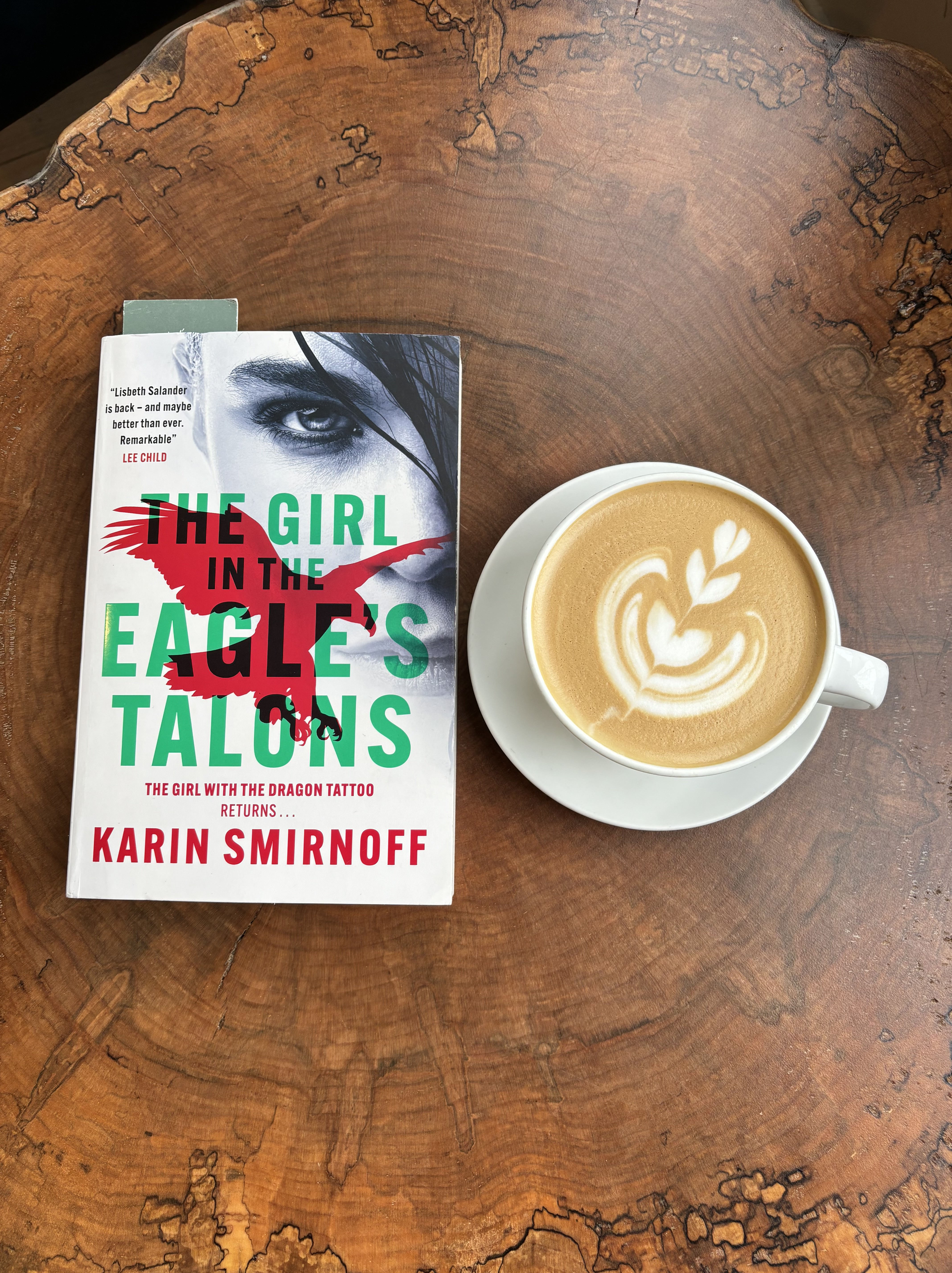
The Millennium Series has reached book seven with The Girl in the Eagle’s Talons. A new author has taken the reigns, and Karin Smirnoff has gone beyond my expectations with her first contribution.
Stieg Larsson’s initial vision for the series ran the course of ten novels, for which he had outlined. He turned in the initial trilogy to the publisher and died shortly thereafter. David Lagercrantz took up the series and ran a trilogy of his own, contributing more quality work that veered away from Larsson’s outlines. Karin Smirnoff offers a fresh take that maintains the quality storytelling while exploring critical analysis of characters that has resulted in growth. Lisbeth Salander has been seemed so human on the page, as Larsson and Lagercrantz sought to make her more of an enigma. Smirnoff’s interpretation of Salander has graced her with a personality (especially in her dialog, both internal and with other people) that had been lacking in previous novels for the sake of maintaining a persona shrouded in mystery.
There are bits of humor where I hadn’t noticed any in previous novels. Smirnoff uses her narrative voice to amplify the internal dialog of whoever is on the page in a given moment/scene. When an unruly man presents violent intent, Lisbeth intervenes to protect a friend and makes an observation…SIDE NOTE-I’m sitting in my living room…end of the night…knee deep in reading this book. I’m wearing the singular pair of sweatpants I own…the only pair I’ve ever owned-a gift I’ve had for less than a month…when I come across this line, “thank you God for making sweatpants the uniform of men with defective genes” (178). These thoughts are peppered throughout the novel and add to the narrative quality that brings these characters to life.
This more expressive Salander may be the result of a familial relationship where her bloodline isn’t out to kill her. Svala is a thirteen year old on the edge of being submitted to the foster care system in Sweden. Lisbeth is contacted and tasked with caring for the girl temporarily while the situation gets sorted out. It become clear Svala is in danger, and they’ve more in common than Lisbeth initially wants to admit. Lisbeth acknowledges that the relationship has upended her situation. “Before, she only had herself. Having another person in your life pushes other things to one side” (172).
Another relationship that gets a closer examination than before is that of Mikael Blomkvist and his daughter, Pernilla. Blomkvist has always been a distant lackluster father. His excuse is the same as it was for all the women in his life-that his work as a journalist was blatantly more important. He’s a grandfather now, and his publication is no longer in print…this identity crisis allows him to make room in his life for other people, but it seems a little late to mend these bridges, as Pernilla struggles to accommodate an absent father who suddenly cares…if only a little bit more than before. Old hurt is made new once the action of the story puts stress on these characters, and I’m here for it.
The quality of the narrative voice is what makes this novel. While analyzing the motives of a would-be volunteered killer the narrative voice reflects a self-awareness that still chooses to do wrong, as Peder Sandberg considers that, “An individual always has choices. The destructive ones present themselves most readily because they do not require mutual understanding…whereas unconditional love, altruism and general compassion are acquired, and also take more energy” (324). Another favorite observation focuses on a vulnerable moment with Svala. It’s shown to a voyeuristic audience the way she cries, “In silence so nobody can hear. A valve that opens, lets the excess pressure hiss out and then closes again” (124). These excursions through the thoughts other people can’t quite express is a highlight of this book. A cleaner tasked with killing for hire, has a crisis of conscience as he, “pours himself another drop of whisky and gathers his words. He has never said them out loud. But they have always been playing, like a record that never ends” (279). Whether it’s a matter of choice, sorrow, or selective words, there’s a performative aspect to the things people can’t do in front of others that is shown in a way that reveals the humanity of everyone who is subject of this narrative voice.
I fell in love with the characters and story world. It’s kept me coming back, and I tend to prefer standalone novels. I’ll occasionally check out a sequel or series, but this is the only series of this length I’ve read, and will continue to read…especially if Smirnoff continues to be at the helm. This is a fun read, full of quality.


 Justin Bauer