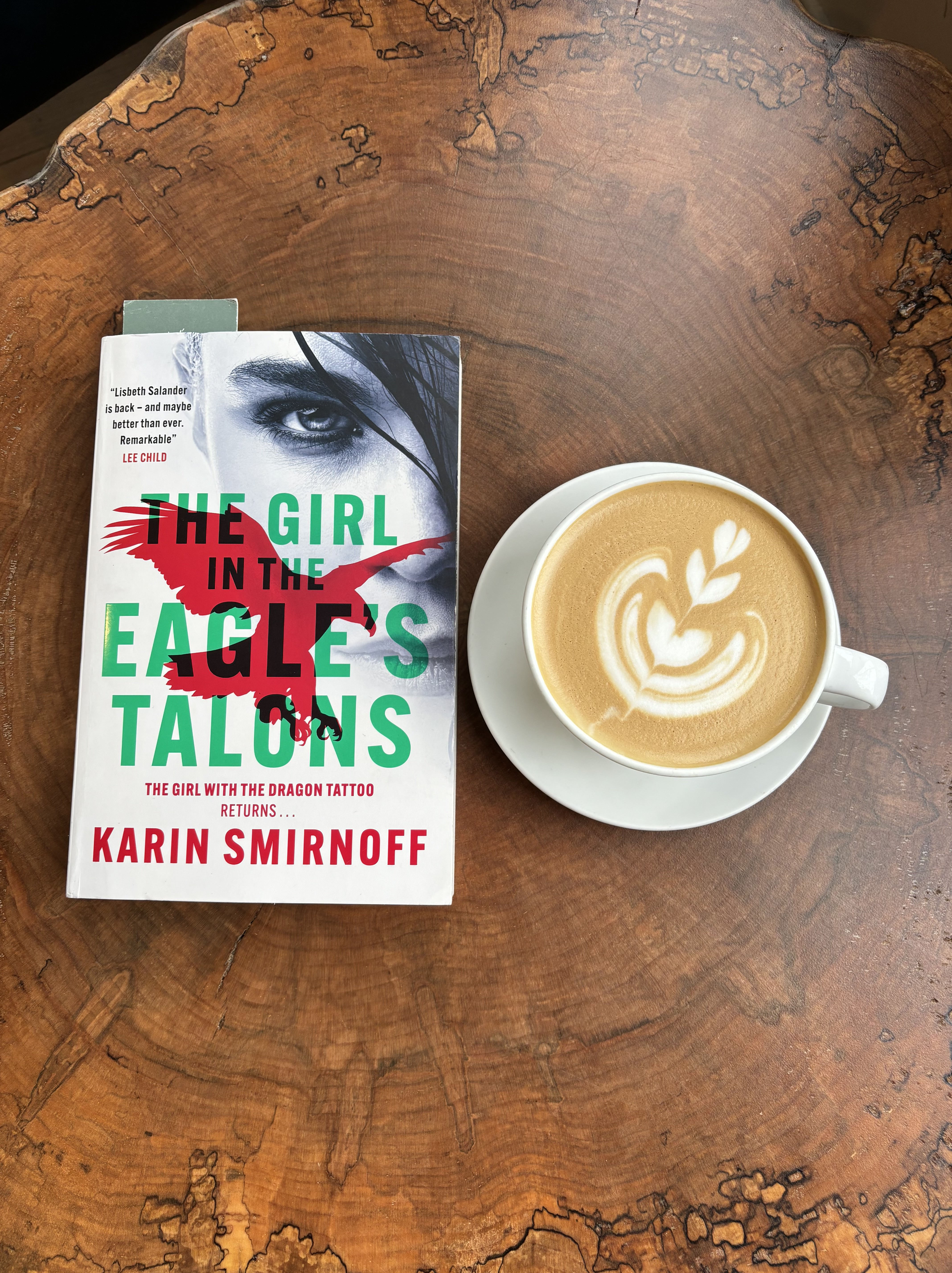
The Girl in the Eagle’s Talons:Rambling Review

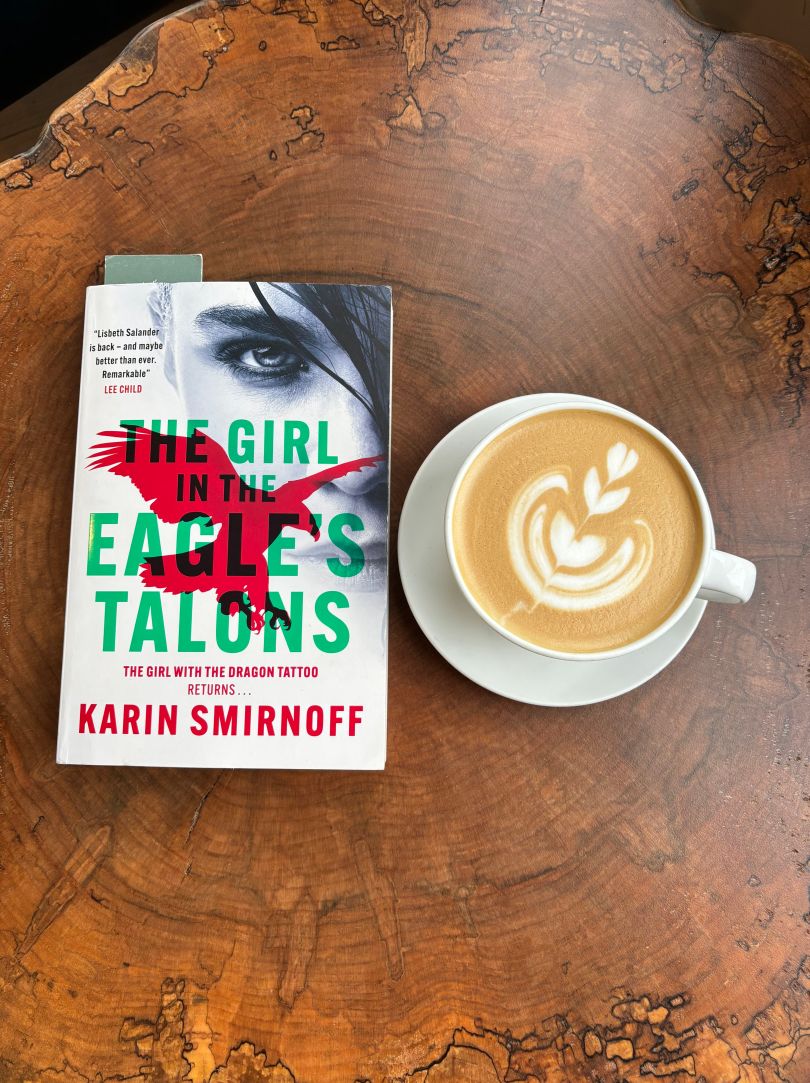
    The Millennium Series has reached book seven with The Girl in the Eagle’s Talons. A new author has taken the reigns, and Karin Smirnoff has gone beyond my expectations with her first contribution.

            Stieg Larsson’s initial vision for the series ran the course of ten novels, for which he had outlined. He turned in the initial trilogy to the publisher and died shortly thereafter. David Lagercrantz took up the series and ran a trilogy of his own, contributing more quality work that veered away from Larsson’s outlines. Karin Smirnoff offers a fresh take that maintains the quality storytelling while exploring critical analysis of characters that has resulted in growth. Lisbeth Salander has been seemed so human on the page, as Larsson and Lagercrantz sought to make her more of an enigma. Smirnoff’s interpretation of Salander has graced her with a personality (especially in her dialog, both internal and with other people) that had been lacking in previous novels for the sake of maintaining a persona shrouded in mystery.

            There are bits of humor where I hadn’t noticed any in previous novels. Smirnoff uses her narrative voice to amplify the internal dialog of whoever is on the page in a given moment/scene. When an unruly man presents violent intent, Lisbeth intervenes to protect a friend and makes an observation…SIDE NOTE-I’m sitting in my living room…end of the night…knee deep in reading this book. I’m wearing the singular pair of sweatpants I own…the only pair I’ve ever owned-a gift I’ve had for less than a month…when I come across this line, “thank you God for making sweatpants the uniform of men with defective genes” (178). These thoughts are peppered throughout the novel and add to the narrative quality that brings these characters to life.

            This more expressive Salander may be the result of a familial relationship where her bloodline isn’t out to kill her. Svala is a thirteen year old on the edge of being submitted to the foster care system in Sweden. Lisbeth is contacted and tasked with caring for the girl temporarily while the situation gets sorted out. It become clear Svala is in danger, and they’ve more in common than Lisbeth initially wants to admit. Lisbeth acknowledges that the relationship has upended her situation. “Before, she only had herself. Having another person in your life pushes other things to one side” (172).

            Another relationship that gets a closer examination than before is that of Mikael Blomkvist and his daughter, Pernilla. Blomkvist has always been a distant lackluster father. His excuse is the same as it was for all the women in his life-that his work as a journalist was blatantly more important. He’s a grandfather now, and his publication is no longer in print…this identity crisis allows him to make room in his life for other people, but it seems a little late to mend these bridges, as Pernilla struggles to accommodate an absent father who suddenly cares…if only a little bit more than before. Old hurt is made new once the action of the story puts stress on these characters, and I’m here for it.

    The quality of the narrative voice is what makes this novel. While analyzing the motives of a would-be volunteered killer the narrative voice reflects a self-awareness that still chooses to do wrong, as Peder Sandberg considers that, “An individual always has choices. The destructive ones present themselves most readily because they do not require mutual understanding…whereas unconditional love, altruism and general compassion are acquired, and also take more energy” (324). Another favorite observation focuses on a vulnerable moment with Svala. It’s shown to a voyeuristic audience the way she cries, “In silence so nobody can hear. A valve that opens, lets the excess pressure hiss out and then closes again” (124). These excursions through the thoughts other people can’t quite express is a highlight of this book. A cleaner tasked with killing for hire, has a crisis of conscience as he, “pours himself another drop of whisky and gathers his words. He has never said them out loud. But they have always been playing, like a record that never ends” (279). Whether it’s a matter of choice, sorrow, or selective words, there’s a performative aspect to the things people can’t do in front of others that is shown in a way that reveals the humanity of everyone who is subject of this narrative voice.

            I fell in love with the characters and story world. It’s kept me coming back, and I tend to prefer standalone novels. I’ll occasionally check out a sequel or series, but this is the only series of this length I’ve read, and will continue to read…especially if Smirnoff continues to be at the helm. This is a fun read, full of quality.
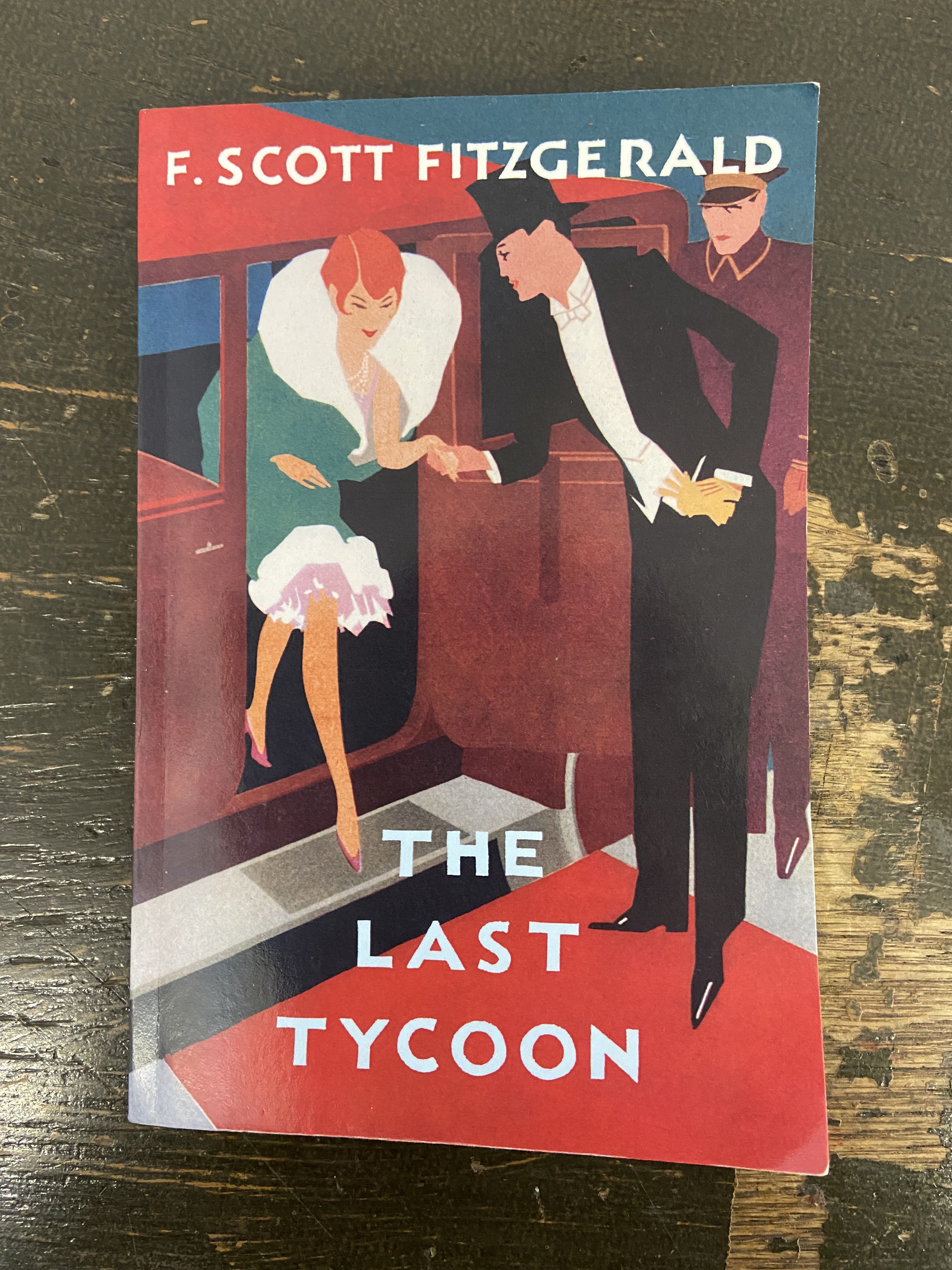
The Last Tycoon:Fitzgerald, Nostalgia, and Writing

The prose of F. Scott Fitzgerald is intoxicating. It’s been a decade since I studied The Great Gatsby at Ohio State, and for the time being I’ve decided to put off rereading that novel until the 100-year anniversary of its initial publication. The Last Tycoon appeals due to the lure of a final novel, one last attempt to satisfy an itch with something new. The unfortunate truth is that the unfinished novel reads like a draft. It jumps on a dime between first and third person, and seems so rough in the early pages that I contemplated whether or not to finish it.

            Monroe Stahr is an elite Hollywood producer who meets Kathleen Moore about halfway through the novel. The trademarked romance of Fitzgerald’s style captivates from that point onward, in spite of the questionable motives that attracts Stahr to Moore in the first place (her looks remind him of his deceased wife). Though the romance fizzles out as Kathleen is to marry another, Monroe carries on and the novel ends rather suddenly due to the death of the author and editorial overreach to reel in the narrative while maintaining a sense of conclusion while there is still quality material.

            Stahr carries the weight of terminal illness, and pushes himself to keep working at the pace he maintained while healthy. It reminds me of a hyper-masculine work culture that romanticizes burnout and exhaustion over questioning why one lives in such a way. “Fatigue was a drug as well as a poison and Stahr apparently derived some rare almost physical pleasure from working lightheaded with weariness…a perversion of the life force he had seen before but he had almost stopped trying to interfere with it…a hollow triumph of killing and preserving the shell,” (110) seems all too commonplace in modern workplace culture. It isn’t ‘rare’ at all in the sense that keeping oneself preoccupied prevents them from critically looking inward. And yet, it’s romantic escapism that reminds one that they are alive…as, “the little trip they made was one of the best times he had ever had in life. It was certainly one of the times when, if he knew he was going to die, it was not tonight.” (112)

            The theme of nostalgia runs through the work of Fitzgerald in such a way as to indulge in the waters in which one will inevitably sink, and reveal it for the comforting lies it tends to offer. The notion that one could have, “passionate loyalty to an imaginary past.” (119) defines Fitzgerald’s work and life. Reconstructing the past seems to be the only future a great many of us can imagine. How good was it really…? And yet…

            One thing literature does is serve as a reminder how much or little things change over time. The tension between Hollywood producers and writers has brought on two writers’ strikes in the twenty-first century. All the conflict about living wages and being able to simply make ends meet while the profits of their labor makes others rich seems to be as old as the establishment of film making as big business. A line from The Last Tycoon shows how much the same it was then, “Writers…they’re the farmers of this business…They grow the grain but they’re not in at the feast. Their feeling toward the producer is like the farmers’ resentment of the city fellow.” (121)

            Again, The Last Tycoon felt like a draft and not a complete novel, but it still managed to contain traces of magic that made it worth the read. I would’ve preferred a world where Fitzgerald lived long enough to finish this one to his standards, but I’m grateful for this glimpse into his process, as it reminds me of Trimalchio.

My Visit with the Goon Squad:Book Review

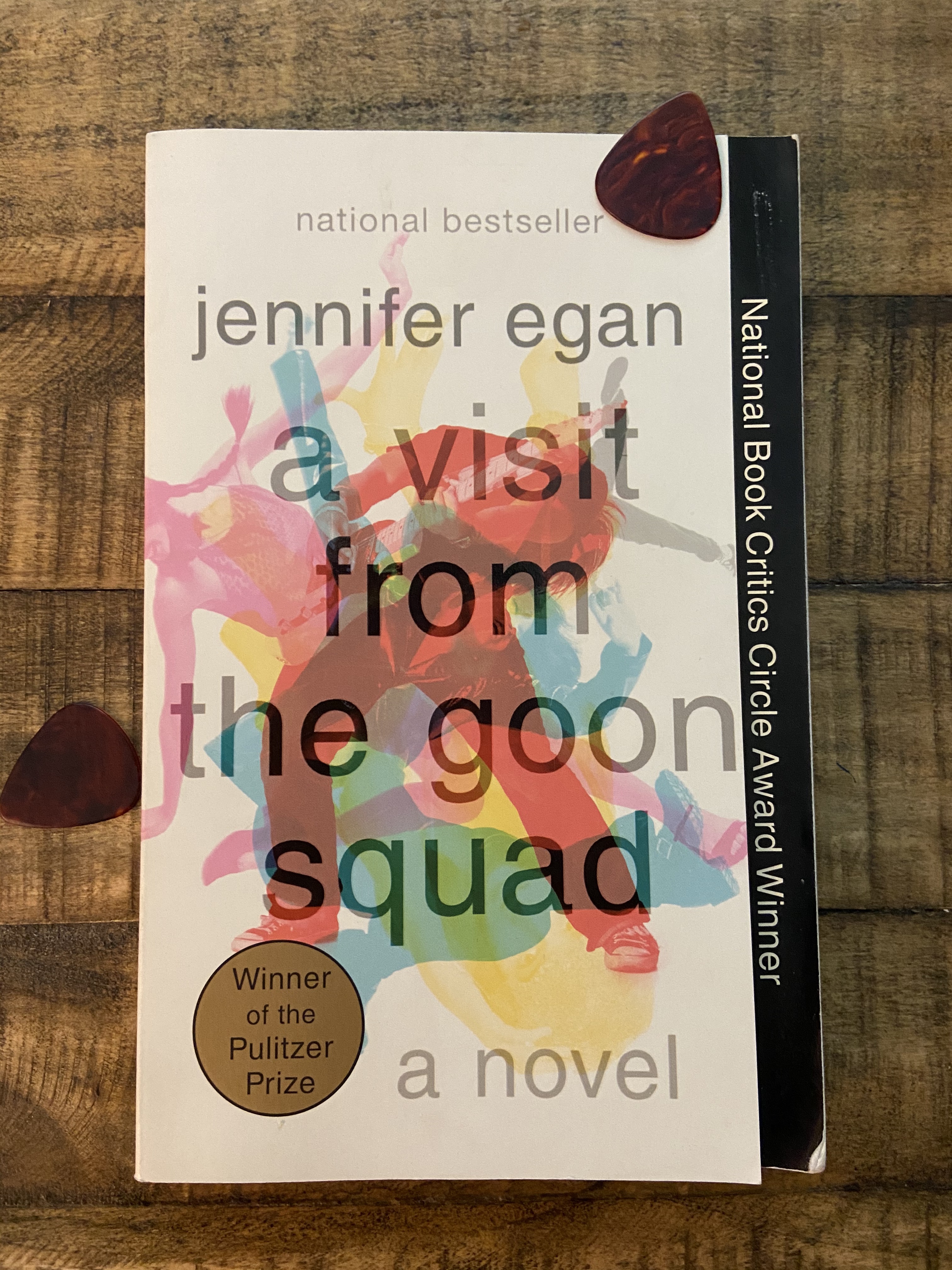
In 2014 I was assigned the first five short stories (chapters) from Jennifer Egan’s A Visit from the Goon Squad. Having been involved with music, I found one instance in the text that I didn’t think was historically accurate, finished my studies, and moved on. It wasn’t until I had started playing with a band on campus that a peer redirected me toward Egan’s novel that I opted to give it another chance…and by another chance I mean I bought a copy and let it reside in my bookcase for a few years. I’ve since moved, got married, had a child, and have read quite a few other books. In 2021 I’ve started thinking about music again, and as I consider my options I decided it was time to give Egan’s Pulitzer Prize winner the chance it deserves.

On one hand, I wish I hadn’t waited so long. On the other hand, I needed this read now. It’s a moving book that captures the human element in a way that tends to be background noise in stories in orbit around the music business. A lineal narrative is withheld for time jumping aesthetics. Each short story is centered on a specific character during a particular moment in history. Some of these characters are vessels for highlighting someone else’s trajectory, and aren’t referenced again, but it’s through the glimpse each story offers that provides this point of contact that makes the world so real. Music producers and A&R people are more than two-dimensional figures for satirical abuse. Hopes and fears are presented through the veil of toxic personalities, and I find myself relating to these characters because of it. They’re imperfect people who ache with want, and I see myself in them. Between each fragmented chapter, I found myself taking a breather. I’d put the book down, sigh, and think, ‘damn…that’s good literature.’ I don’t feel that way with every book, so forgive my abuse of the five star system(it just so happens that I enjoy reading)…this novel is nothing short of absolutely fantastic.

With this read, I’m breaking the ice on a project that I’ve been considering for quite some time. This research is a starting point from which I hope to craft a novel, or possibly a series if I can make that much happen. It feels good to be inspired…that’s how good Egan’s novel is. I’m looking forward to her followup, scheduled for release in April, 2022, The Candy House.

Book Review: Calibration 74

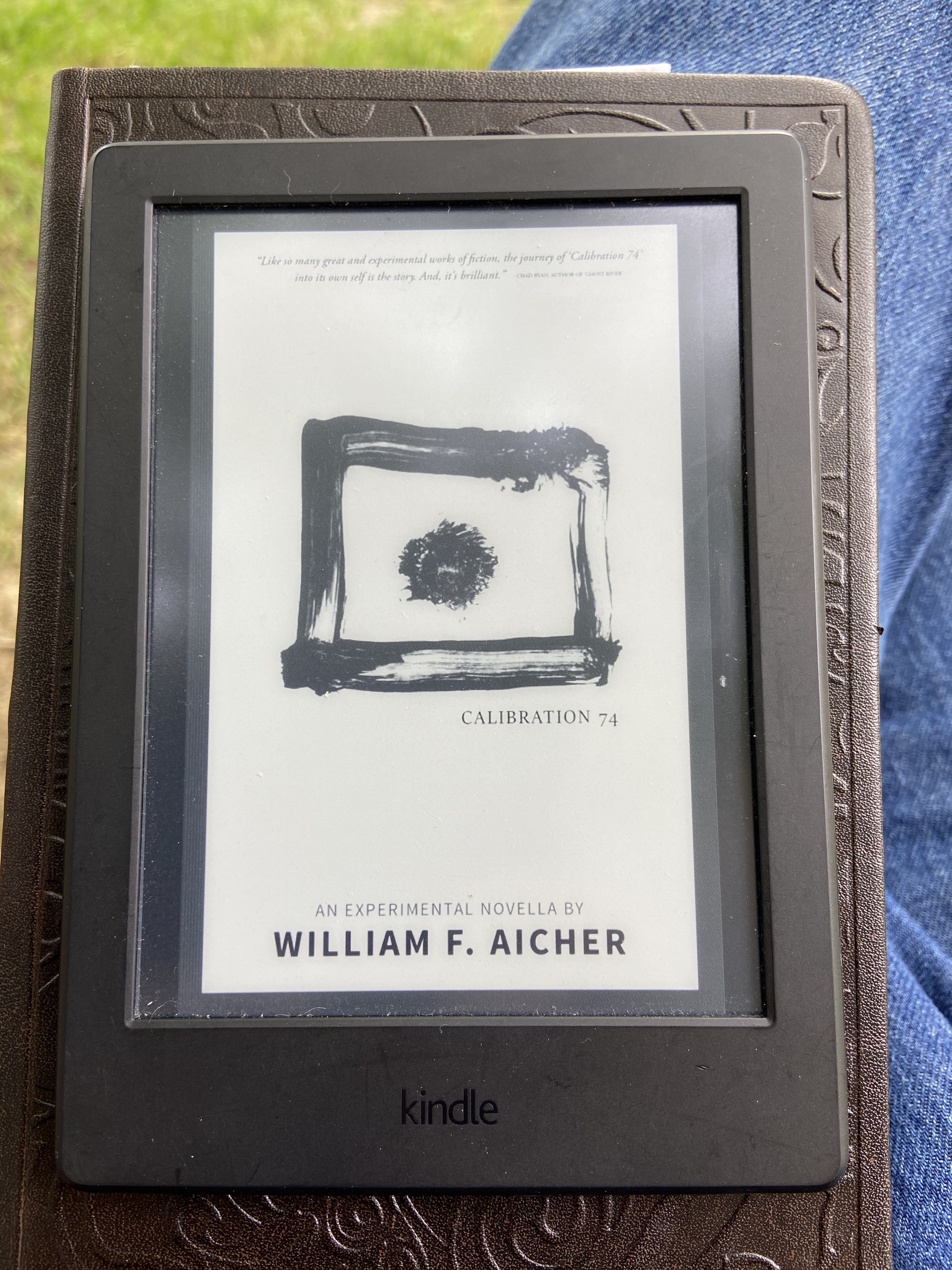
This short book by William F. Aicher is a quick read if you opt to treat it as such. On the other side of the same coin, we find something dense that is better digested in smaller pieces over time. The later is how I decided to approach this work. Aicher takes us through a narrative of a mind that is haunted, though it seeks a closure that can never be found. Short chapters, or ‘calibrations’ offer 74 separate segments over 186 pages. It’s an uncompromising romp through psychological terrain of the damaged variety, right up my ally. Calibration 74 is a harrowing exploration of experimental fiction that is worth a deeper dive, so give it the time of day. 

            Rich in thought provoking prose and vivid imagery, I take solace in relatable poetry, if such a thing should be admitted. Our narrator is unreliable in direct ways that relate to numerical obsession, in the moments where he miscounts. It happened on one occasion where he’s counting large numbers, making big picture statements/asking big picture questions between the numbers, 

[One billion four hundred twenty-eight million two hundred sixty-three five hundred and nine. 

The soul is indistinguishable from the body. 

One billion four hundred twenty-eight million two hundred sixty-three five hundred and nine. 

Where do we go when we die?]

Numerical obsession and the fallacy of the human mind is the vessel that moves the story forward. Before and after this hiccup, the count progresses as expected. This break from the logical pattern is enough to suggest the blur is intentional. 

I found solace in the rhythmic use of language. It’s a scattered collection of ashes and even at my slow pace I struggled with authorial intent, so I placed my own meaning where I saw fit. Between the covers, Aicher’s philosophical background is in full view. Direct answers are elusive, but that’s the fun of this kind of read. I definitely recommend Calibration 74. Give it a read.

The Little Demons Inside: A Book Review

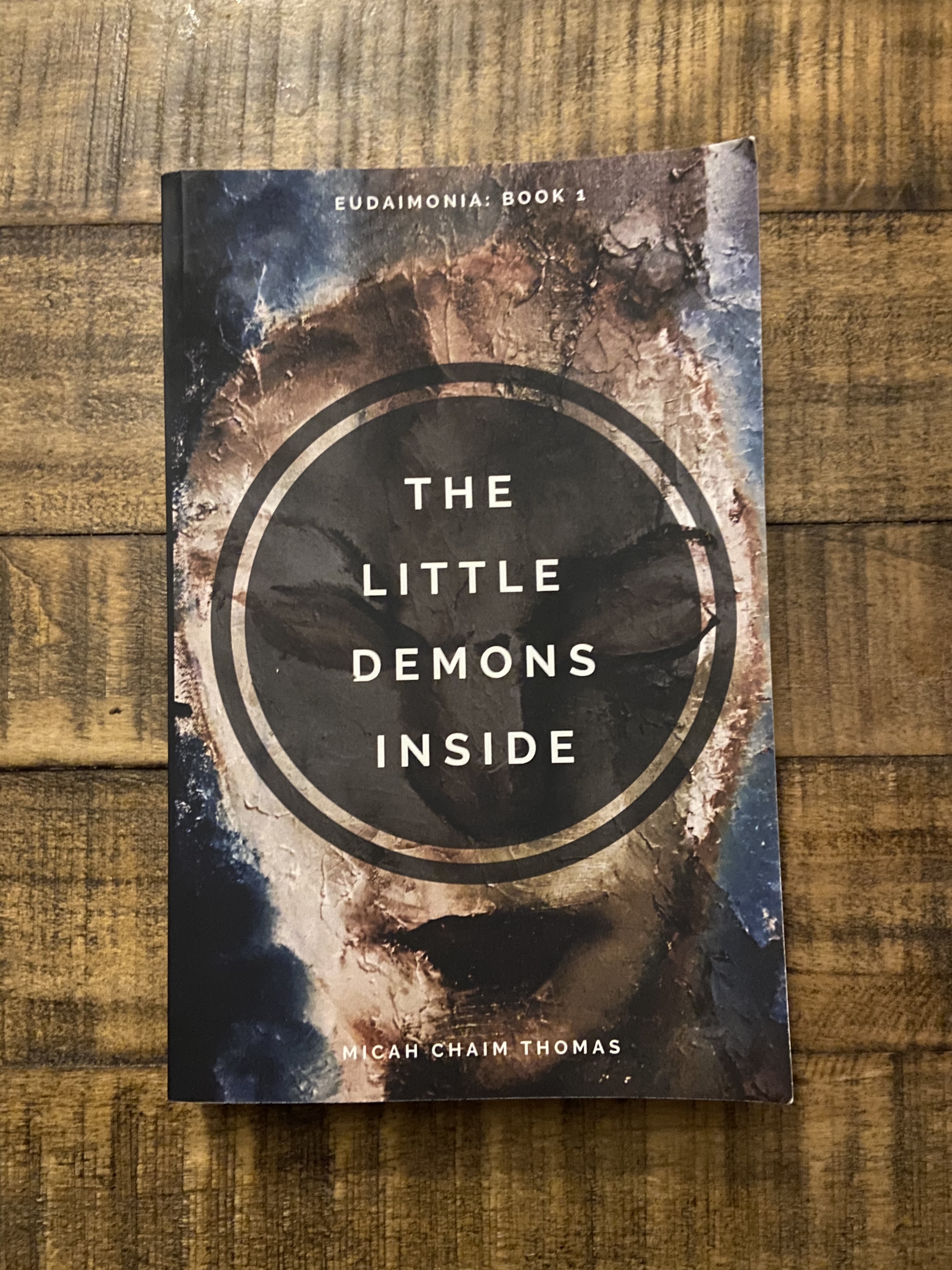
In a story that follows multiple people, I found myself knee deep in personal reflection. The Little Demons Inside by Micah Chaim Thomas supplied me with a full range of emotion through clear, thoughtful prose. He’s created a story world that is all too real. It’s not a place I want to live, but I’m afraid we may occupy a version of it. 

The book opens with fire and action, we’re given chemistry that lingers and becomes romance, and the horrors of corrupt people with power threaten us from all angles. The writing is strong, transitions are fluid, and the characters are fleshed out people who have brought me to care. 

Various characters, coupled with the narrator offer personal insight that critiques human nature with modern technology. As we’re still breaking the ice, I caught a line that seems a familiar thought to me. While describing smartphones, “You see, these narcissism toys, they keep us looking at the surface, they keep us from searching inward” (72). What we find by the end of the novel is that internal vision…and it’s bleak. The constant cultural conditioning to be the best little cog you can be is only overshadowed by a dream where your digitized narcissism is harvested for profit, leaving the subject apathetic or depressed. As with social media, you are the product. The algorithm figures you out, and your own tendencies become the fruit for an advertising campaign. The story doesn’t beat you over the head with this, but it’s where I found myself.

Though the darkness of the philosophy wants to exist in a vacuum, Thomas offers various insights to humor and humility that shines through. We’re left with a quality novel that fulfilled my expectations in that I was both made to think, and entertained.